




Ferrite powder will be one of the strategically relevant materials in industry in 2026. What was once primarily regarded as a classic magnetic material for inductors or transformers is now a key component for electromagnetic compatibility (EMC), high-frequency applications and functional coatings.
Particularly in the context of Radiation protection coatings - more precisely in the field of electromagnetic radiation protection - ferrite powders are becoming increasingly important. Rising power densities, higher switching frequencies, miniaturisation and increasing regulatory EMC requirements are shifting the focus from pure shielding to targeted absorption.
This article looks at the current market situation, technical differences between ferrite types and the role of ferrite powders in modern EMC and radiation protection coatings.
1. why ferrite powder will become strategically more important in 2026
The demand for ferrite powders is increasing in several industries at the same time:
- Electromobility (inverters, control units, charging infrastructure)
- Power electronics (higher switching frequencies)
- Semiconductor technology & high-frequency systems
- Power generation & stationary storage
- Industrial automation
- 5G and communication applications
Increasing electrification not only increases power density, but also sensitivity to electromagnetic interference fields. EMC is no longer just a testing or approval issue, but an integral part of product design.
Already in our article „Secure decisive competitive advantages with ferrite powders“ we outlined the growing importance of magnetic materials for industrial competitive advantages. The focus is now increasingly shifting to specialised applications such as EMC absorbers and functional coatings.
2. market situation and procurement situation for ferrite powder
Growth drivers: electrification, frequency increase and EMC printing
Demand for ferrite powders in 2026 will not be driven by a single industry sector in isolation, but by several megatrends running in parallel.
The electrification of mobility is leading to an increasing number of power electronic assemblies in vehicles, such as inverters, onboard chargers or DC/DC converters. These systems operate at higher switching frequencies and generate complex electromagnetic fields that need to be controlled.
At the same time, the power density of machines, drives and control systems is increasing in the industrial environment. The more compact and powerful systems become, the more sensitive they are to electromagnetic interference. EMC is therefore becoming not only a regulatory factor, but also a functional quality factor.
Also in the area of Power generation, In the field of inverters for photovoltaics, stationary battery storage and grid technology in particular, the requirements for magnetic components and EMC optimisation are increasing.
Ferrite powders are increasingly being used here as functional materials to specifically attenuate or control electromagnetic fields.
Raw materials and supply chain perspective: stability is not a given
Although ferrite powders consist mainly of iron oxides, the specific properties only result from the combination with other elements.
With NiZn ferrites nickel and zinc play a central role. Nickel continues to be subject to global price fluctuations, geopolitical influences and changes in supply. Zinc markets react sensitively to stock levels and industrial demand.
With MnZn ferrites manganese in particular is a relevant factor that is regarded as a strategic raw material in the European context.
Strontium-based hard ferrites are in turn dependent on other market mechanisms.
For industrial buyers, this means
- Raw material prices have an indirect effect on ferrite powder prices
- geopolitical developments influence availability
- Supply chains must be organised in a resilient way
- Long-term partnerships are gaining in importance
Ferrite powders are therefore not an interchangeable commodity product. Quality, specification and delivery stability are crucial for process reliability.
This systematic approach is in line with the structured purchasing logic of our Metal powder purchasing guide.
3. ferrite types at a glance - which differences really count
Not all ferrites are the same. The selection of the right type depends largely on the frequency range, the desired magnetic characteristics and the subsequent application. The differentiation between soft ferrites and hard ferrites is particularly important for EMC and radiation protection coatings.
MnZn ferrite powder
The MnZn ferrite powder Mf197 is a soft magnetic ferrite powder with high permeability, which is particularly suitable for applications in the kHz to lower MHz range.
Properties:
- Very high magnetic permeability
- Suitable for applications down to the lower MHz range
- High magnetic efficiency
Typical areas of application:
- Transformers
- Inductances
- Power electronics
- EMC filter
- Electromagnetic absorbers in the kHz-MHz range
MnZn ferrites are particularly interesting when magnetic near-field components are to be specifically damped.
NiZn ferrite powder
The NiZn ferrite powder is a soft magnetic ferrite powder with high electrical resistivity that is suitable for higher frequencies and HF applications.
Properties:
- High electrical resistivity
- Suitable for higher frequencies (MHz to HF range)
- Reduced eddy current losses at higher frequencies
Typical areas of application:
- High-frequency inductors
- Antenna applications
- EMC interference suppression components
- HF absorber
NiZn ferrites are the preferred choice when higher frequency bands are addressed or conductivity-related losses need to be minimised.
Sr Ferrite powder (hard ferrite)
The Sr ferrite powder is a hard magnetic ferrite powder with a high coercive field strength that is primarily used for permanent magnet applications.
Properties:
- High coercivity
- Permanently magnetisable
- Chemically stable
Areas of application:
- Electric motors
- Generators
- Permanent magnet applications
For radiation protection coatings, soft ferrites are generally in the foreground, as the magnetic loss characteristic is decisive here and not the permanent magnetisation.
4. radiation protection in an industrial context: shielding vs. absorption
In an industrial environment, „radiation protection“ does not usually mean protection against ionising radiation (e.g. X-rays or gamma), but rather protection against electromagnetic radiation in the sense of EMC (electromagnetic compatibility).
This involves the control of:
- Conducted faults
- radiated interference fields
- Near-field couplings
- Resonance effects in enclosures
- high-frequency emissions
Physical principles: three mechanisms
Electromagnetic shielding is basically based on three effects:
- Reflection
- Absorption
- Multiple reflection within the material
Classic metallic shielding (e.g. aluminium or copper enclosures) works primarily via Reflection. The electric field is reflected at the conductive surface.
Problem:
Reflection does not reduce energy, it shifts it.
In complex assemblies, this can lead to:
- Hot Spots
- Housing resonances
- Antenna effects
- unwanted feedback
lead.
Why ferrite powders play a special role here
Ferrite materials have a complex magnetic permeability (μ = μ′ - jμ″).
- μ′ → Storing portion
- μ″ → lossy portion
The lossy component (μ″) is crucial for absorber applications.
Ferrite powders convert electromagnetic energy into heat via magnetic losses. This mechanism is known as magnetic loss attenuation.
Especially for:
- magnetic near fields (kHz-MHz)
- Switching frequencies of inverters
- high-frequency interference
ferrites are significantly more effective than purely conductive shielding materials.
Frequency dependence is crucial
The effectiveness of a ferrite-based radiation protection coating is highly frequency-dependent.
- MnZn ferrite → High permeability, ideal for lower frequencies down to the MHz range
- NiZn ferrite → Higher electrical resistivity, suitable for higher frequencies
The wrong choice leads to
- the magnetic loss curve is outside the target band
- although the coating is present, it does not provide effective damping
This is one of the most common planning errors.
Absorber coating vs. classic shielding

Both principles are often combined in modern electronic systems:
- Conductive external shielding
- Ferrite-based absorber coating inside
Relevance for industrial applications
With increasing power density and higher switching frequencies, magnetic interference components become more relevant.
Typical problem areas:
- Inverters in electric vehicles
- Switching power supplies
- High-frequency power electronics
- Tightly packed control units
- Machine controls
Ferrite powders in coatings enable targeted frequency band attenuation without having to use additional solid metal structures.
This makes them particularly attractive for:
- Weight optimisation
- Installation space reduction
- Retrofit solutions
- Complex housing geometries
5. ferrite powder in radiation protection and EMC coatings
Ferrite powders are increasingly being integrated into functional coating systems.
Typical systems:
- Epoxy resin coatings
- Polyurethane coatings
- Silicone-based systems
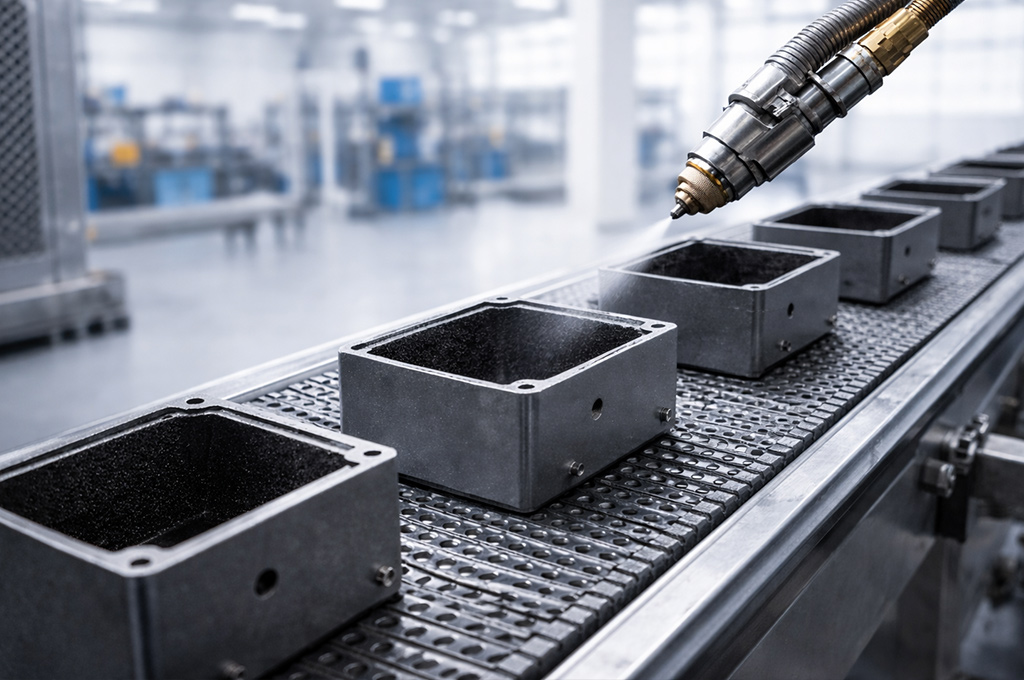
- Spray coatings
- Cast resin formulations
- Internal housing coatings
Not only the type of ferrite plays a role here, but also:
- Particle size distribution
- Dispersibility
- Miscibility
- Flowability
- Layer thickness
- Filling level
In context Surface coatings these parameters are particularly critical.
Sectors with high relevance
Ferrite-based EMC and radiation protection coatings are relevant wherever powerful electronic systems are integrated in a confined space and electromagnetic interference fields need to be controlled.
Typical industries with particularly high relevance are
- Electrical engineering: EMC optimisation in control systems, control cabinets and industrial electronic systems.
- Semiconductor Technology & Electronics: Protection of sensitive components from high-frequency interference fields and minimisation of signal interference.
- Automotive industry: EMC management in inverter technologies, control units and high-voltage systems of electric vehicles.
- Energy generation: Attenuation of electromagnetic interference in inverters, transformers and stationary storage systems.
- Machine and tool construction: Reduction of interference in automated production systems and complex drive systems.
With increasing system complexity, the importance of targeted EMC concepts and thus the use of ferrite-based absorber solutions is growing in all these sectors.
6. typical errors in the procurement of ferrite powder for EMC coatings
Strategic errors often occur, especially with radiation protection coatings:
1. wrong frequency band taken into account
MnZn and NiZn are interchanged, although they are optimised for different frequency ranges.
2. no clear PSD definition
particle size distribution:
- Dispersibility
- Homogeneity
- Layer quality
- Performance stability
3. dispersibility underestimated
Agglomerates lead to:
- Inhomogeneous layers
- Power fluctuations
- local weak points
4. no defined test methodology
Comparability requires clear test setups and reproducible measurement conditions.
5. only price considered instead of system
Ferrite powder for EMC coatings is a system material and not just a filler.
This logic is in line with the structured purchasing approach in the NMD buying guide.
7. decision matrix for industrial buyers
The selection of ferrite powder for radiation protection and EMC coatings should never be made in isolation. In practice, several parameters interact: frequency band, field characteristics, application method, coating design and delivery stability.
For buyers, this means
Not just „Which ferrite?“ is the right question, but:
- Which frequency band should be attenuated?
- Is it primarily magnetic near fields or high-frequency radiation?
- Should it be reflected or absorbed?
- How is the powder introduced into the coating system?
- What requirements apply with regard to batch consistency and documentation?
The following matrix serves as a practical guide for typical industrial scenarios. It does not replace technical validation, but helps to compare supplier offers in a structured manner and simplify internal coordination between engineering and purchasing.
In addition to the choice of ferrite type, the following points should also be specified as binding:
- Particle size distribution (PSD)
- Purity and impurity content
- Dispersibility in the binder
- Batch consistency
- Delivery and supply security
The performance of coating systems in particular is not only dependent on the material, but also on the system. An inadequately defined specification can lead to the coating being technically correctly formulated, but not achieving the desired attenuation in the relevant frequency band.
The following therefore applies to industrial decision-makers:
Ferrite powders for radiation protection coatings are not a standard material, but a functional material that has to be specifically selected, tested and qualified.
8 Why NMD as a partner is crucial
Ferrite powders for radiation protection coatings are not standard off-the-shelf products. They are functional materials whose selection has a direct influence on EMC performance, process stability and ultimately on the reliability of your entire assembly.
Wrong decisions rarely become apparent immediately, but often only during operation:
- Unstable EMC values
- Limit values exceeded during tests
- Unexplained interference signals
- Additional development cycles
- Time-consuming and cost-intensive improvements
This is precisely where a pure supplier differs from a strategic partner.
NMD - New Materials Development GmbH has more than 25 years of experience in the field of metal powders and supports customers from over 50 industries. We not only know the materials, but also the requirements of modern power electronics, EMC concepts and industrial coating systems.
Our claim is not just the supply of ferrite powder, but:
- Selecting the right type of ferrite
- Tuning to your frequency band
- the evaluation of the particle structure
- Ensuring consistent quality
- Strategic procurement in a volatile raw materials environment
We understand the perspective of purchasers, development engineers and quality managers alike. Because ferrite powder is not a secondary material, but a building block of your system stability.
9 Conclusion: Ferrite powders are a strategic material for EMC stability
With increasing electrification, higher switching frequencies and growing system complexity, electromagnetic compatibility is becoming a key competitive factor.
Ferrite powders perform more than just a magnetic function. They are used in radiation protection and EMC coatings:
- Targeted absorption of electromagnetic energy
- Reduction of resonance effects
- Stabilisation of sensitive electronics
- Compliance with regulatory limits
- More compact and lighter system designs
The decision in favour of the right ferrite powder has an influence:
- Development effort
- Testing effort
- Production safety
- Long-term reliability
- Total costs over the product life cycle
In a market environment with increasing raw material risks and growing EMC sensitivity, the choice of material is not a question of detail - it is a strategic decision.
To the overview of our ferrite powder solutions
Because the stability of your system starts with the right choice of material.