






For many manufacturing companies, soldering powder is a natural part of production - until problems occur. Voiding, tombstoning, wetting problems or unexpected price increases for Tin or silver quickly show that solder powder is not an interchangeable consumable. It is a strategic production factor.
In 2026 in particular, several influencing factors will intensify simultaneously:
- volatile commodity prices (tin, silver, bismuth),
- increasing demand from the semiconductor, AI and e-mobility markets,
- regulatory developments (RoHS, REACH, 3TG),
- increasing miniaturisation in the SMT sector,
- increasing demands on process stability and documentation.
This guide is aimed at purchasers, project managers and technical decision-makers in the industry. It combines market analysis, technical principles and strategic procurement so that you not only select soldering powder, but also consciously control it.
1. market trends 2026: Why solder powder is becoming more strategic
Tin as a key cost driver
The majority of industrial solder powders are based on tin. Tin is therefore not just an alloy component, but a strategic raw material. Demand is largely driven by:
- Electronics production,
- semiconductor industry,
- Automotive and e-mobility,
- Energy and storage technologies
driven.
Increasing digitalisation, AI applications and power electronics are leading to a structural increase in demand for solder alloys, particularly in the area of lead-free systems such as SAC (SnAgCu).
Silver and bismuth components
With SAC alloys, the silver content has a direct impact on costs. A higher Ag content (e.g. in SAC405) means improved mechanical properties but also higher material costs.
Low-melting systems such as Sn42Bi58 or Sn42Bi57,6Ag0,4 benefit from their low thermal budget, but are dependent on the availability of bismuth. Export controls and geopolitical tensions can have a direct impact on prices and supply availability.
What this means for purchasing
Whoever procures soldering powder 2026 must:
- Keep an eye on price trends,
- Check alloy alternatives,
- Establish secondary sources,
- Clearly define specifications,
- and regulatory requirements.
Soldering powder is therefore not only a technical decision, but also an economic one.
2 What is solder powder - and why is it more than just „solder“?
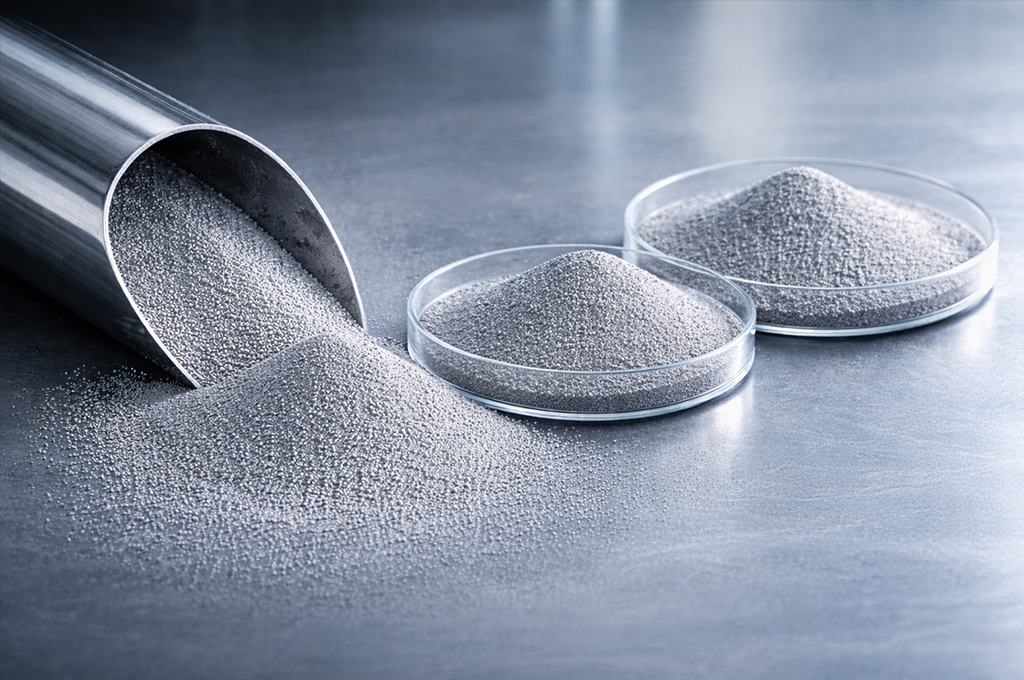
Solder powder consists of finely atomised metal particles of a defined alloy. It is usually used in combination with fluxes as a solder paste in SMT and reflow processes.
Compared to wire or bar soldering, soldering powder offers the same advantages:
- precise dosing capability,
- high automation capability,
- reproducible print images,
- controllable melting processes.
If you would like to find out more about grain distribution, oxygen content and influencing factors, we also recommend our existing technical article:
What you should know about soldering powder to achieve ideal results
This new article builds on this and expands it to include market and purchasing aspects.
3. industrial comparison of alloy systems
3.1 SAC systems (SnAgCu) - industry standard in SMT
SAC305 (Sn96.5Ag3Cu0.5) is the globally established standard for lead-free SMT applications.
Typical variants of NMD:
You can find an overview of all systems here: Industrial soldering powders
Advantages:
- Good wetting
- Mechanical stability
- Proven process window
- Broad industrial acceptance
Trade-offs:
- higher silver content = higher price
- Higher reflow temperature compared to SnBi
SAC405 with 4 % silver offers increased thermal cycle stability. Relevant for automotive and demanding industrial applications.
3.2 Tin-lead alloys (e.g. Sn63Pb37)
Sn63Pb37 is eutectic (melting point 183 °C) and offers a very defined melting behaviour.
Examples:
Advantages:
- sharp melting point
- Proven processes
- Very good wetting behaviour
Risks:
- Not RoHS-compliant (except for exemptions)
- Increased documentation and safety requirements
3.3 Low-melting-point systems - SnBi
Sn42Bi58 (melting point approx. 138 °C) is ideal for:
- Temperature-sensitive assemblies
- LEDs
- Sensors
- Hybrid assemblies
Examples:
Advantages:
- Reduced thermal stress
- Energy saving in reflow
- Suitable for sensitive substrates
Please note:
- more brittle properties
- Dependence on the bismuth market
3.4 Silver-free alternatives - Sn100 & SnCuNiGe
Sn100 (pure tin) or micro-alloyed systems such as SnCu0.6Ni0.05Ge:
- Cost stability
- Reduced dependence on silver
- Stable process control with correct validation
Examples:
These systems are particularly interesting when the focus is on cost optimisation or raw material risks.
4 T3, T4, T5 - why particle size is crucial
In addition to the alloy, the particle size is one of the most important influencing factors when selecting solder powder. The categorisation into T3, T4 or T5 describes the size class of the powder particles and is based on industrial standards (e.g. IPC J-STD-005).
Why is this relevant?
Because the particle size has a direct influence on:
- the print image for stencil printing
- the filling of fine apertures
- the flow behaviour of the paste
- the susceptibility to oxidation
- Wetting and voiding
In principle, the following applies: The smaller the particles, the larger the surface area per kilogramme of powder. However, a larger surface area also means greater reactivity and therefore a greater tendency to oxidise. Finer powders are therefore more efficient with very small structures, but at the same time more sensitive to storage, moisture and process fluctuations.
Typical classification

T3 is the robust industry standard for classic SMT applications with a stable process window.
T4 is used when finer structures need to be printed. For example, for high layout density or smaller components.
T5 is intended for very fine geometries and requires particularly clean process control and harmonised storage conditions.
Important for decision-makers:
Finer powders are not a general quality upgrade. They increase the process requirements. The choice of powder class should therefore always be derived from the layout, printing requirements and process window - not from habit or price considerations.
You can find further basic information on grain distribution and oxygen content in our technical article: What you should know about soldering powder to achieve ideal results
5. applications: Where soldering powder 2026 is used
The areas of application for solder powder are now broader and more demanding than ever. With increasing miniaturisation, rising power density and higher quality requirements in the industry, the precise selection of solder alloy and powder class is becoming even more important.
Soldering powder is used wherever electrical connections need to function reliably over the long term. Often under thermal, mechanical or cyclical stress. The powder used not only influences the quality of the individual solder joint, but also the process stability of the entire production line.
Typical industrial applications are
- SMT and reflow processes
- Wave and selective soldering
- Hybrid assemblies
- Power and high-current applications
- Temperature-sensitive assemblies (e.g. LEDs, sensors)
In addition to classic electronics applications, solder powder also plays a role in industrial hard and soft soldering. The focus here is on mechanical strength, temperature resistance and corrosion behaviour.
Further information can be found here: Hard & soft soldering
Particularly in sectors such as Electrical engineering, Automotive industry, Power generation or Semiconductor technology the choice of the right soldering powder is closely linked to reliability, service life and product liability.
6. typical errors in the industrial purchase of soldering powder
Here we deliberately adopt the mindset of our shopping guide: Purchasing guide for metal powder
Mistake 1: Only compare the price per kilo
Material costs often account for less than 10 % of the total costs of an SMT process. A supposedly cheaper powder can:
- Higher reject rates
- More rework
- Unstable print images
- Increased downtimes
cause.
Error 2: Do not define a PSD specification
If only „T3“ is ordered but no clear PSD tolerance is defined, batch deviations may occur.
Mistake 3: Ignoring the oxygen content
Oxidised particles lead to:
- poorer wetting
- Increased void formation
- higher flux requirement
Mistake 4: Underestimating storage
Solder paste is typically stored at 2-8 °C. Incorrect temperature control or mixing old paste with fresh paste can drastically impair performance.
Error 5: Not checking compliance
Lead-containing systems without correct exception documentation can cause legal risks. Conflict minerals (tin as 3TG) are also becoming increasingly relevant for audits.
7. decision matrix for buyers
In practice, purchasers are often faced with the challenge of having to choose between several technically suitable solder alloys. It is not just a question of melting point or conformity to standards, but also a balanced decision between process stability, cost structure, thermal requirements and regulatory framework.
The following matrix serves as a guide for typical industrial scenarios. It does not replace technical validation, but it does help to make a well-founded pre-selection and to structure internal coordination between purchasing and technology.
The important thing is: This decision should always be made together with production and quality assurance. In addition to the alloy, the powder class, particle size distribution, storage conditions and process window play a decisive role.
The matrix shows typical guard rails. Final approval should always be based on sample tests, reflow profiles and process validation.
8 Why NMD as a partner is crucial
Solder powder is not a standard consumable material. It is a process-critical material that has a direct influence on quality, reject rates and production reliability.
Wrong decisions often only become apparent during operation: through unstable print images, increased voiding rates or complaints from the end customer. This is precisely where a pure supplier separates itself from a strategic partner.
NMD - New Materials Development GmbH - has more than 25 years of experience in metal powder procurement and supports customers from over 50 industries. We combine market knowledge, technical expertise and international supply chains with personal, direct advice.
Our aim is not only to supply solder powder, but also to select the right alloy, powder class and specification. Tailored to your application and your process window.
9 Conclusion: Solder powder 2026 is a strategic decision
The choice of soldering powder influences:
- Process stability
- Long-term reliability
- Compliance
- Cost structure
In an environment of increasing raw material volatility and growing quality requirements, material decisions are becoming increasingly strategic.
If you make a conscious choice of alloy, particle size and specification (and don't just look at the price per kilo), you reduce risks and strengthen your own competitiveness.
To the overview of our industrial soldering powder solutions
Because the quality of your assembly starts with the right choice of material.