






Stationary battery storage systems are evolving from a supplementary component into a cornerstone of modern energy systems.
They store surplus electricity, shift energy to periods of higher demand, stabilise electricity grids and help businesses to better manage peak loads and fluctuating energy prices.
By 2025, the European market had reached a whole new level. According to figures from SolarPower Europe, across Europe there were around 36 GWh of new battery storage capacity installed.
Total operational capacity thus exceeded 100 GWh for the first time. More than half of the new capacity came from large, grid-connected storage systems.
As the market grows, so too does the demand for suitable materials for battery cells, electrodes, current-carrying components, thermal management and structural components.
In this context, terms such as Nickel, Aluminium or Metal powder used without making a sufficient distinction between the specific form and function of the material.
Nickel in a battery is not necessarily metallic nickel powder.
Similarly, depending on the system, aluminium may be required in the form of foil, an alloy, a housing material, oxide, solid electrode material or powder.
The choice therefore depends not only on which metal is specified, but also on the role it is intended to fulfil in the energy storage system.
NMD Metalpowders offers Nickel and aluminium powder for modern energy systems A range of metallic powders of varying grades for industrial and scientific applications.
Whether Nickel powder or Aluminium powder However, whether it is suitable for a specific energy storage project depends on the battery chemistry, material function, particle structure, purity and further processing.
This article provides an overview of the economic development of the storage market, explains the different roles played by nickel and aluminium, and outlines which powder properties should be specified in a technical enquiry.
Key points at a glance:
- Europe’s battery storage market is entering a phase of industrial growth.
- Large grid storage systems have now become the most important driver of growth.
- Lithium iron phosphate dominates today’s residential mass market, but it is not the only storage chemistry.
- Metallic nickel powder may be of particular relevance in sodium-nickel chloride systems and specialised electrode structures.
- Aluminium can be used as an active metal, a precursor or a material for lightweight, thermally conductive system components.
- Nickel and aluminium powders are not direct alternatives; rather, they serve different functions.
- Purity, particle size distribution, morphology, surface area and batch-to-batch consistency must be suitable for the application.
Europe’s storage market is entering a new phase of growth
The expansion of solar and wind energy is increasing the need for flexibility in the electricity system. Electricity generation and consumption do not always coincide.
Battery storage systems can store energy when there is plenty of electricity available and release it again at times of higher demand.
Following the European Battery Market Outlook 2026–2030 The European battery storage market grew by 48 per cent in 2025. The newly installed capacity of 36 GWh increased the total European installed capacity to more than 100 GWh.
For the European Union alone, SolarPower Europe reports 27.1 GWh of new capacity. Of this, 55 per cent was accounted for by large-scale storage systems.
The market is thus clearly shifting from predominantly private home storage systems towards larger, grid-connected and commercial projects.
Large-scale battery storage systems are set to become the key driver of growth
Utility-scale storage systems are connected directly to electricity grids, power generation facilities or large industrial consumers.
Depending on how they are designed, they can perform a variety of tasks:
- short-term stabilisation of grid frequency and power
- Time-shifted supply of solar and wind power
- Reducing output curtailment during periods of high feed-in
- Provision of balancing energy and other system services
- Reducing the load on individual sections of the network
- Protection of critical consumers
As project size increases, so too do the requirements in terms of safety, service life, maintainability, documentation and long-term availability of materials.
A material that delivers good results on a laboratory scale is therefore not automatically suitable for an industrial storage platform.
Why electricity grids need ever greater flexibility
Solar and wind power generate electricity depending on the weather and the time of day. At the same time, electric vehicles, heat pumps, data centres and electrified production processes are changing the consumption pattern.
Battery storage systems cannot completely resolve these fluctuations, but they can make an important contribution:
- Electricity is carried over from periods of high generation to later hours.
- Peak loads can be absorbed at short notice.
- Power generation facilities can be marketed in a more predictable manner.
- Network bottlenecks can be reduced in appropriate cases.
- Reserve capacity is available more quickly than with many conventional systems.
The International Energy Agency describes battery storage as the fastest-growing technology in the electricity sector at present. Worldwide, around 108 GW of new battery capacity was installed in 2025 – some 40 per cent more than in the previous year.
Storage is becoming an economic factor for businesses
The economic importance of battery storage systems is also growing for industrial and commercial enterprises. They can be used to manage electricity consumption and operational load profiles in a more targeted manner.
Possible use cases include:
- Peak load management: Short-term peaks in consumption are smoothed out by stored energy.
- Optimising self-consumption: Solar power generated on-site is used at a later date.
- Dynamic electricity prices: Energy can be stored when prices are low and used when prices are higher.
- Uninterruptible power supply: Critical processes are provided with a short-term transitional or alternative solution.
- Network services: Depending on the market and technical specifications, storage facilities can generate additional revenue.
For energy-intensive companies, storage can therefore form part of a comprehensive energy and production strategy.
However, cost-effectiveness depends on electricity prices, load profiles, operating modes, cycles, degradation, financing and the regulatory framework.
Regulation and safety are becoming increasingly important
As the use of stationary battery storage systems becomes more widespread, the requirements for technical documentation and product safety are increasing.
The EU Battery Regulation contains specific requirements for stationary battery storage systems.
Among other things, manufacturers must demonstrate that their systems are safe when used as intended.
The technical documentation must set out the relevant safety tests, risk assessments and measures to mitigate potential hazards.
Greater attention is also being paid to the origin of materials and security of supply. The European Critical Raw Materials Act sets out both Bauxite, aluminium oxide and aluminium as well as Battery-grade nickel classified as strategic raw materials.
For procurement, this means:
- Material grades must be clearly specified.
- Supply chains and sources of supply are becoming increasingly important from a strategic perspective.
- Batches and test results must be documented in a way that allows for traceability.
- Recycling and the circular economy are becoming increasingly important.
- Long-term supply arrangements should be assessed at an early stage.
You can find further background information in our technical article on the Impact of global supply chains and raw material risks on metal powder procurement.
Stationary battery storage systems are more than just lithium-ion systems
The term ‘stationary battery storage’ encompasses a range of cell chemistries and system designs.
They differ, amongst other things, in terms of energy density, power, cycle stability, temperature range, safety, cost and the availability of raw materials.
Lithium iron phosphate dominates today’s energy storage market
Lithium iron phosphate batteries – LFP for short – currently account for the largest share of newly installed stationary battery storage systems worldwide. The IEA estimates that their share will be around 90 per cent by 2025.
The reasons include:
- relatively low cell costs
- good cycle stability
- high thermal stability
- Elimination of nickel and cobalt from the cathode material
- well suited to frequent charging and discharging cycles
This market dominance is important for classifying the material: The growth in stationary storage systems does not automatically lead to a proportional increase in demand for metallic nickel powder. Nickel is not a main component in LFP cathodes.
Nickel and aluminium nevertheless remain relevant – in other cell chemistries, as functional materials, and in components of the entire storage system.
Nickel-based battery systems for specialised applications
In addition to lithium-ion batteries, there are stationary energy storage technologies in which nickel plays a much more direct role. These include, amongst others:
- Sodium-nickel chloride batteries
- Nickel-iron batteries
- Nickel-metal hydride systems
- Selected research and hybrid systems
These technologies differ significantly in terms of their design and operating conditions.
Sodium-nickel chloride batteries, for example, operate at elevated temperatures and utilise a solid ceramic sodium-ion conductor and a molten secondary electrolyte.
Nickel can be used there as a metallic raw material or as a component of the positive electrode. In other nickel-containing batteries, however, the active materials are often present as oxides, hydroxides or complex compounds.
Aluminium-based storage technologies as a field of development
Aluminium has been studied for many years as a potential energy source and electrode material.
The reasons for this are its high theoretical storage capacity, wide availability and good storability as a metal.
The concepts examined include:
- Aluminium-air batteries
- rechargeable aluminium-ion batteries
- Aluminium-sulphur and other aluminium-metal systems
- long-term chemical storage systems based on an aluminium cycle
Many of these approaches are still at the research stage, in pilot phase or confined to specialised niches.
Challenges include, amongst other things, corrosion, passivation, electrolytes, side reactions and electrical rechargeability.
For NMD projects, a clear distinction must therefore be made between available metallic aluminium powders and to distinguish between this and the market readiness of a complete battery system.
Other stationary storage technologies
The energy storage market is technologically more diverse than nickel, aluminium or lithium-ion batteries.
Other systems include, for example:
- Sodium-ion batteries
- Redox-flow batteries
- Lead-acid systems
- Metal-air batteries using other metals
- Hydrogen and chemical energy carriers
- thermal storage systems
- Flywheels and compressed air storage tanks
The choice of technology depends on the storage duration, performance, location, cycle profile, costs and safety requirements.
Metal powders can fulfil a direct electrochemical function in certain technologies or be used for components in the surrounding system technology.
Where metallic powders can be used in a battery system
A stationary battery storage system does not consist solely of the active material inside the cell.
It comprises cells, modules, power distribution, power electronics, cooling, housings, sensor technology and safety systems.
Metal powders can therefore play a significant role at various stages of the value and manufacturing chain.
Active material is not necessarily metallic powder
Battery specifications often list the metals they contain.
However, this does not directly indicate the required dosage form.
Nickel can, for example, be found in the following forms:
- metallic nickel powder
- Nickel oxide
- Nickel hydroxide
- Nickel chloride
- A component of a complex cathode material
- Nickel alloy or coating
Aluminium may be required as:
- solid electrode metal
- Aluminium foil
- aluminium alloy
- metallic aluminium powder
- Aluminium oxide
- Component or housing material
The name of the metal alone is therefore not sufficient for a reliable enquiry about the material.
Metal powder as a component of electrodes
In certain battery systems, metallic powders can contribute directly to the function of the electrodes.
Depending on the cell design, they serve, for example, as:
- electrochemically active material
- conductive structure
- porous electrode network
- Carriers for other active ingredients
- Raw material for granulated or sintered electrodes
In porous electrodes, particle size, morphology and compaction influence both electrical conduction pathways and mass transfer, as well as the reaction surface area.
Metal powder as a raw material and intermediate product
Even though the powder no longer exists as loose metal powder in the finished battery system, it can still be an important raw material.
Possible production steps include:
- Pressing and sintering porous electrodes
- Production of pastes and suspensions
- Coating of substrates and current-carrying conductors
- Structure of metallic composites
- additive manufacturing of functional components
- Production of catalytically or electrically active surfaces
The requirements for the powder vary considerably depending on the process.
A powder used to make a paste must have different properties to a powder used for pressing, sintering or 3D printing.
Metal powders for components outside the battery cell
Nickel and aluminium powders can also be tested for use in components across the entire energy system.
These include:
- Heat sinks and heat exchangers
- Housings and lightweight structural components
- electrical contacts and connectors
- corrosion-resistant coatings
- Power electronics components
- additively manufactured functional components
For conductive and heat-dissipating components, it is also possible to Copper powder be relevant.
The article „Choosing the right copper powder“ explains the key selection criteria.
Our technical article illustrates the possibilities offered by metal 3D printing „Additive Manufacturing for Europe’s Industry“.
You can find the NMD portfolio at Metal powder for additive manufacturing.
Power electronics, semiconductor technology and magnetic components
As well as battery cells, stationary energy storage systems also require inverters, DC converters, battery management systems, sensors and other electronic components.
In the Semiconductors and electronics Metal powders can be used, amongst other things, for conductive compounds, heat-dissipating components, coatings and high-precision components.
Nickel, aluminium and copper materials can be used for different purposes:
- electrical contacts and conductive structures
- Heat dissipation from power semiconductors
- Heat sinks and electronically connected housings
- corrosion-resistant functional coatings
- additively manufactured power electronics components
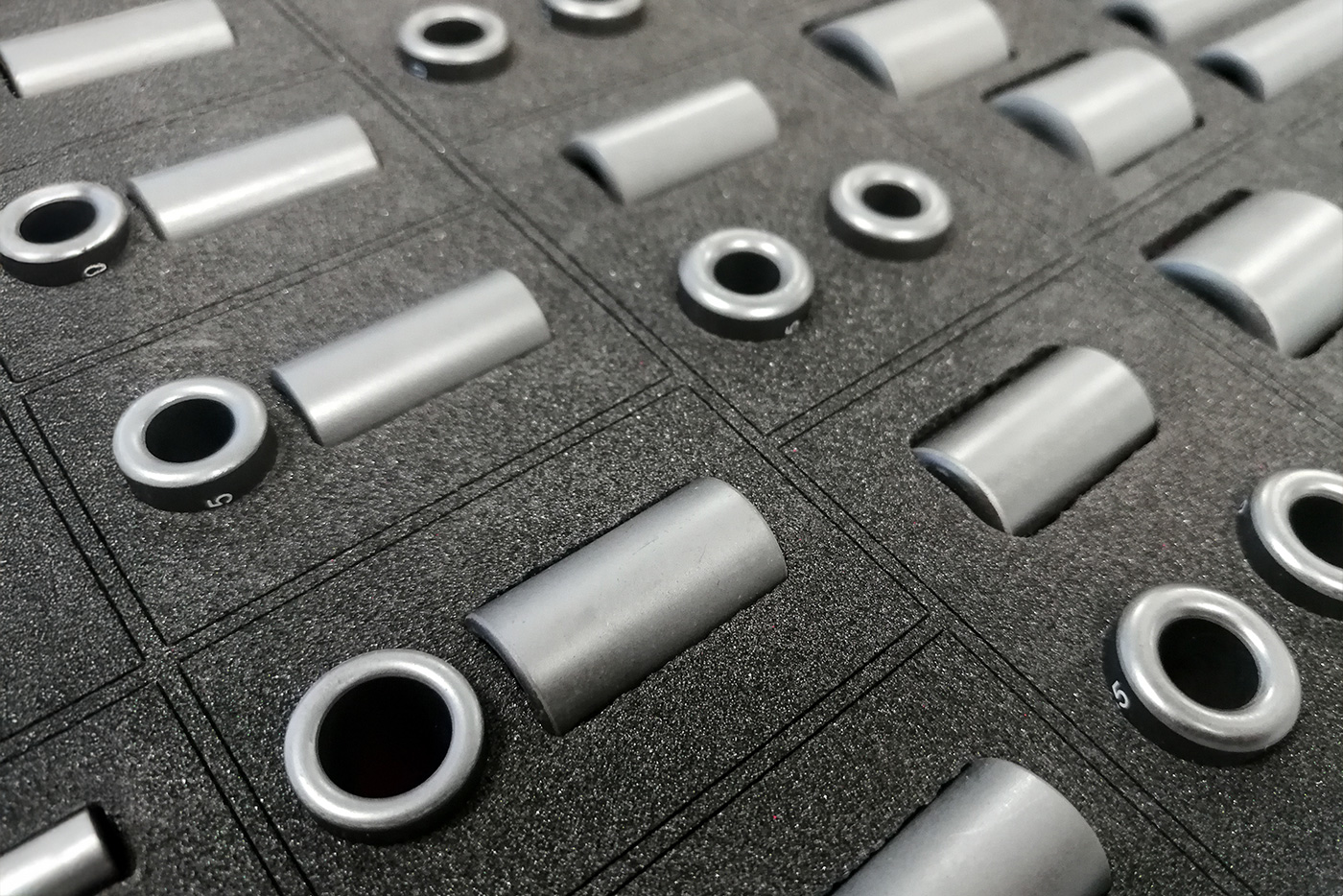
In addition, inverters and current transformers contain magnetic components such as chokes, inductors, transformers and filters.
For this magnetic applications Specially formulated ferrite or magnetic powders are often required.
Nickel and aluminium powders are not necessarily the most suitable core materials in this context.
Magnetic components have their own specific requirements in terms of permeability, power loss, frequency response and temperature stability.
The choice of powder should therefore be made separately from the choice of material for the cell, casing or thermal management system.
What role does nickel powder play in stationary energy storage systems?
Nickel has good electrical conductivity, corrosion resistance and temperature resistance.
These properties make the metal an attractive option for a range of battery and energy technology applications.
However, the specific role of nickel powder depends heavily on the battery chemistry and the electrode structure.
Nickel powder in sodium-nickel-chloride batteries
Sodium-nickel chloride batteries are among the applications of metallic nickel in stationary storage systems for which there is the clearest technical evidence.
They operate at elevated temperatures and use sodium on the negative side and nickel-containing materials within the positive electrode.
During charging, metallic nickel is converted into nickel chloride. During discharging, the reaction proceeds in the opposite direction.
In modern research cells, studies are being carried out on, amongst other things, porous nickel and nickel-iron electrodes.
Recent research shows that such systems may be of interest for stationary energy storage. At the same time, they place particular demands on:
- Electrode porosity and material distribution
- Resistance to molten electrolytes
- Temperature control
- ceramic electrolytes and seals
- Cell geometry and industrial manufacturability
A planar sodium-nickel chloride system presented in 2023 incorporated cost-effective nickel-iron electrodes and operated at around 300 °C.
The research thus highlights both the potential and the continuing need for further development of this technology.
Whether a particular nickel powder from NMD Metalpowders is suitable for such a system must be assessed on the basis of particle size, morphology, purity, electrode formulation and cell process.
Conductive networks and porous electrode structures
In a porous electrode, the structure must fulfil several functions simultaneously:
- provide electrical pathways
- allow for a sufficient reaction area
- Transporting electrolytes and reaction products
- Record changes in volume during operation
- maintain mechanical stability
Depending on the system, metallic nickel powder can serve as a starting material for such structures.
The particle size distribution influences packing and porosity, whilst morphology and surface area help to determine contact and reaction behaviour.
Whilst a very fine powder does increase the specific surface area, it can at the same time lead to greater agglomeration and make dosing more difficult.
A coarser structure may be easier to handle, but it offers a different reaction surface and packing.
Correctly defining nickel-containing active materials
In many batteries, nickel is not present as a pure metal.
Examples include:
- Nickel-manganese-cobalt oxides in lithium-ion cathodes
- Nickel-cobalt-aluminium oxides
- Nickel hydroxide in alkaline battery systems
- Nickel chloride in sodium-metal chloride batteries
- Nickel oxide in research and electrode materials
These substances have different chemical properties to metallic nickel powder.
They can be produced from nickel-containing feedstocks, but are not the same as a product made from pure nickel.
„Nickel-containing battery“ does not automatically mean „battery made from nickel powder“. When making an enquiry, it must be clarified whether metallic nickel, a nickel oxide, nickel hydroxide, nickel chloride or a complex cathode material is required.
Further applications in modern energy systems
In addition to battery cells, nickel powder can be tested for other energy-related applications:
- electrical contacts and conductive structures
- corrosion-resistant components
- Coatings and surface treatments
- catalytic components
- Fuel cells and electrolysis
- additively manufactured high-temperature and functional components
Suitable areas of application include the Electrical engineering, the Surface coating and the Power generation.
What role does aluminium powder play in stationary energy storage systems?
Aluminium combines low weight with good thermal conductivity and widespread industrial availability.
As a metal, it can also store energy electrochemically or release energy during an oxidation reaction.
Here, too, a clear distinction must be made between the element aluminium and the specific form in which it is supplied.
Many battery systems use solid or foil-form aluminium anodes, not necessarily aluminium powder.
Aluminium as an active metal in aluminium-based battery systems
In aluminium-air batteries, metallic aluminium forms the negative electrode.
Oxygen from the ambient air is incorporated into the electrochemical reaction at the positive electrode.
Aluminium has properties that make it well-suited to such systems:
- high theoretical energy capacity of the metal
- widespread availability of raw materials
- relatively good shelf life when dry
- well-established recycling infrastructure
- low material weight
Many aluminium-air systems use sheets, plates or specially alloyed anodes.
Aluminium powder can be investigated in research, paste, porous electrode or chemical energy storage concepts.
Not every aluminium-air battery requires aluminium powder.
Aluminium powder as an energy carrier for long-term storage
Some research approaches regard aluminium not merely as a traditional electrode material, but as a chemical energy carrier.
Electricity is initially used to produce aluminium or to maintain an aluminium cycle.
During subsequent oxidation, the stored energy can be harnessed as electricity, heat or hydrogen.
Such concepts could prove interesting in the long term for longer storage periods, as metal can be stored for extended periods without continuous self-discharge.
Challenges include, amongst other things:
- Overall efficiency of the cycle
- Aluminium recovery
- Material and process costs
- Reaction control
- Handling reactive powders
- Establishing closed-loop recycling systems
These approaches are not intended as a universal replacement for current lithium-ion batteries, but rather represent a field of research and development for specific long-term applications.
The natural oxide layer as a technical trade-off
Aluminium forms a thin layer of oxide very quickly when exposed to air.
This passivation protects the metal from further corrosion and helps to ensure it has a long shelf life.
In electrochemical applications, however, the same layer can hinder the transport of charge and mass.
In the case of aluminium-air batteries, passivation, self-corrosion and hydrogen evolution are among the key technical challenges.
The following factors are particularly relevant for aluminium powder:
- Particle size: Smaller particles have a larger specific surface area.
- Oxide layer: The thickness and composition of the surface affect reactivity and storage.
- Humidity: Inappropriate storage conditions can compromise quality and safety.
- Alloys and impurities: They can alter corrosion and electrochemical reactions.
- Packaging: It must be appropriate for the reactivity, quantity and planned storage period.
A particularly fine aluminium powder is therefore not automatically the best solution.
Whilst the increased surface area can accelerate reactions, it can also increase oxidation, dust formation and safety requirements.
Thermal management and lightweight components
Aluminium powder can also be used as a raw material for components outside the cell. Lightweight and thermally conductive components are particularly relevant.
Possible applications include:
- Heat sinks and cooling structures
- Heat exchanger
- Housings and module components
- lightweight structural components
- Power electronics components
- additively manufactured components with integrated cooling channels
For such applications, the additive manufacturing enable complex geometries and functionally integrated cooling solutions.
The specific powder quality must be suitable for the plant, the alloy and the process approval.
Distinguishing between aluminium foil, aluminium powder and aluminium oxide
The three forms of material fulfil different functions in battery systems:
- Aluminium foil: It is used in many lithium-ion cells as a current conductor for the positive electrode.
- Aluminium powder: Can be used as a metallic raw material, reactant or feedstock for components.
- Aluminium oxide: It is a ceramic material and is being investigated for use in, amongst other things, coatings, separators and electrical insulation.
A enquiry regarding „aluminium for batteries“ must therefore first clarify which of these material forms and functions is required.
Nickel or aluminium? Why neither material is a direct alternative
Nickel and aluminium can both be relevant in energy storage projects, but they generally serve different purposes.
The choice is not between two metals that are broadly interchangeable, but between specific material functions.

The battery chemistry and the intended function of the material must be established first.
Only then can it be determined whether metallic nickel, aluminium or a chemical compound is required.
Which powder properties are crucial for energy storage?
Even once the correct type of metal has been identified, the selection process is not yet complete.
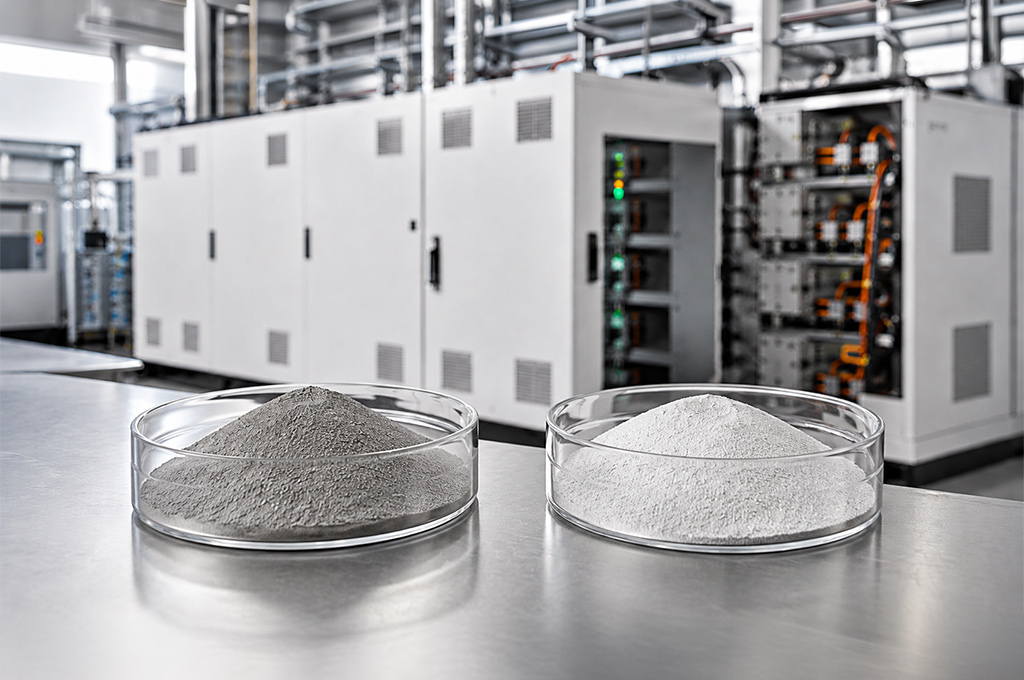
Metal powders differ in terms of, amongst other things, purity, particle size distribution, morphology, surface characteristics, flowability and density.
Chemical purity
Foreign substances can affect electrical conductivity, reactivity, corrosion and ageing. The level of purity required depends on the function of the powder.
The term „high-purity“ on its own is often too vague for technical procurement. It is better to specify concrete minimum concentrations and limit values for relevant impurity elements.
When making an enquiry, you should therefore provide the following details:
- desired minimum content of the main metal
- Critical contaminants and permissible limit values
- Test method
- Requirements for certificates of analysis
- permissible variations between batches
Particle size and particle size distribution
The particle size distribution influences the specific surface area, packing, porosity, reaction rate and processability.
Depending on the application, it affects:
- Dosing capability
- electrical contact points
- Electrode porosity
- Sintering behaviour
- Coating quality
- Flowability
- Susceptibility to oxidation
Further background information can be found in the technical article on Particle size of metal powders and its impact on production.
Grain shape and morphology
Metal powders can be spherical, irregular, dendritic, porous or platelet-shaped, amongst other forms.
The appropriate morphology depends on the manufacturing process and the desired function.
Examples:
- Spherical particles can be advantageous in processes where dosing and flow are critical.
- Dendritic structures can provide numerous contact points and a large surface area.
- Irregular particles can affect the compaction and anchoring behaviour.
- Porous particles may be of interest for electrode structures.
- Plate-shaped particles can impart special properties to coatings or conductive systems.
No single morphology is therefore inherently better than another. It must be suited to the processing and the target structure.
Surface and oxidation state
In the case of metallic powders, the surface area is significantly larger in relation to the mass of the material than in the case of solid materials. This means that the surface condition becomes all the more important.
Relevant examples include:
- natural oxide layers
- adsorbed moisture
- organic residues
- Surface coatings
- Passivation
- Storage and transport conditions
In the case of aluminium powder, the oxide layer is particularly important. It protects the material, but can limit its electrochemical activity or sinterability.
In the case of nickel powder, the surface and state of oxidation can also influence conductivity, catalytic activity and processability.
Flowability and ease of dosing
For automated coating, mixing, pressing or additive processes, it must be possible to convey and distribute the powder in a controlled manner.
Flowability depends, amongst other things, on:
- Particle size
- Fine fraction
- Morphology
- Surface roughness
- Humidity
- Conurbation
A powder with a high specific surface area may be of interest from an electrochemical point of view, but at the same time it places greater demands on dosing and process stability.
Bulk density and packing behaviour
Bulk density and compactability influence how much material can be packed into a defined volume. In electrode structures, they affect porosity, contact points and mass transport.
A high density is not automatically the best option in every application. Porous electrodes, for example, require sufficient open pathways for the electrolyte and reaction products.
Batch consistency and traceability
For series production projects, relevant properties must remain consistent across multiple deliveries. These include:
- chemical composition
- Particle size distribution
- Morphology
- Density and flow behaviour
- Surface condition
- Packaging and storage
Certificates of analysis, batch numbers and defined test methods support traceability. Where there is a recurring need, long-term supply capability should be taken into account as early as the development stage.
Which applications benefit from stationary battery storage systems?
Grid-connected large-scale storage systems
Large-scale storage systems can balance out short-term fluctuations, provide balancing power and improve the temporal utilisation of renewable energy.
Depending on the system requirements, the focus may be on high performance, long storage life, cycle stability or safety.
The cell chemistry used determines whether nickel, aluminium or other materials are relevant within the cell.
Solar and wind farms with battery storage
The combination of renewable energy generation facilities and battery storage systems enables a more predictable feed-in.
Surplus energy can be stored and made available at a later date.
Possible benefits include:
- less throttling
- more targeted marketing
- Smoothing out generation peaks
- Provision of additional network services
Commerce and Industry
Businesses use storage for purposes including self-consumption, load management and safeguarding critical processes.
In industrial projects, in addition to the cells, power electronics, cooling, enclosures and electrical connection technology are particularly important.
This means that metallic powders can also play an important role outside the active cell material.
Data centres and uninterruptible power supply
Data centres require a highly available and responsive power supply.
Battery systems bridge power cuts, stabilise internal networks and ensure a smooth transition to other backup power sources.
The IEA recorded significant growth in battery-powered uninterruptible power supplies in 2025.
Rising demand for electricity driven by digital infrastructure is likely to further boost this sector.
Island grids and decentralised energy systems
In remote regions, industrial island grids or decentralised supply systems, battery storage can link renewable generation with consumption and reserve capacity.
Alternative battery technologies may also be of interest here if, for example, a long service life, robust operating conditions or reduced dependence on certain raw materials are more important than maximum energy density.
However, the use of a storage device does not automatically mean that metallic nickel or aluminium powder is used in it. The specific cell and system architecture remains the decisive factor.
Common mistakes when selecting metal powders for energy storage systems
1. Confusing the name of the metal with the required form of the material
A request for „nickel for batteries“ or „aluminium for energy storage“ does not specify whether metal powder, oxide, hydroxide, chloride, foil, alloy or component material is required.
This distinction should be clarified before starting the search for a supplier.
2. Do not define the function in the battery system
The powder can be used for a variety of purposes:
- Active material
- conductive structure
- Electrode framework
- Coating
- Catalytic converter
- Component material
- thermal component
Without this information, a supplier can hardly assess what levels of purity, morphology and particle size are appropriate.
3. Enquire about purity only
Two powders with the same metal content may behave very differently during the process.
Particle size distribution, morphology, surface area and density can be just as important as chemical purity.
4. Transferring laboratory results directly to mass production
A successful laboratory-scale test or individual sample does not in itself prove industrial scalability. With larger quantities, the following may change:
- Mixing and dosing behaviour
- Heat and mass transfer
- Batch-to-batch variations
- Processing times
- Safety requirements
- Packaging and storage solutions
Considering sampling, pilot batch quantities and production requirements at an early stage reduces the risk of problems later on when switching over.
5. Blurring the lines between market readiness and the state of research
Stationary lithium-ion storage systems are now an established mass market.
By contrast, many aluminium-based battery systems are still at various stages of research and development.
An interesting laboratory result should therefore not be presented as proof of a storage solution ready for series production.
6. Do not request a sample
Technical data sheets enable a preliminary selection to be made. However, actual suitability must be tested in the intended process.
A sample can help:
- To assess processing and dosing
- To test the properties of electrodes or components
- Adjusting process parameters
- To define quality criteria for future batches
- Avoiding buying the wrong items when purchasing larger quantities
What buyers and developers should look out for when making an enquiry
The more precisely the technical enquiry is worded, the more accurately we can assess whether a suitable powder grade is available.
Key details for a powder enquiry
- Material function: Active material, conductive structure, coating, component or thermal component
- Battery system: for example, sodium-nickel chloride, aluminium-air or another chemical system
- Material type: metallic powder, oxide, hydroxide, chloride, alloy or other material
- Purity: Minimum content and relevant limits for foreign substances
- Particle size distribution: Desired size class and permissible proportions of fine and coarse particles
- Morphology: for example, spherical, irregular, dendritic or porous
- Surface condition: Oxidation, passivation or coating
- Processing method: Pressing, sintering, coating, mixing or additive manufacturing
- Quantity: Laboratory, sampling, pilot or production requirements
- Packaging: Packaging size, protective atmosphere and storage requirements
- Documentation: Test report, certificate of analysis and traceability
- Delivery planning: a one-off or recurring requirement
If any details are missing, NMD Metalpowders can work with you to determine what information is still required for an initial material selection.
Frequently asked questions about metal powders for stationary energy storage systems
Finding the right metal powder partner for energy storage projects
In energy storage projects, a metal powder should not be selected solely on the basis of the type of metal and the price per kilogram.
The key factor is whether the material form, particle structure, purity and documentation are suitable for the intended process.
Using powder of an unsuitable quality can lead to additional development cycles, unstable processes, quality issues and delays in scaling up.
NMD Metalpowders supports companies and research organisations in:
- the classification of the required material form
- the selection of suitable nickel and aluminium powders
- the optimisation of purity and particle size distribution
- the procurement of sample and production quantities
- the examination of various international sources of supply
- compliance with packaging and documentation requirements
- the confidential handling of development projects
About our tailor-made powder solutions We support you every step of the way, from the initial technical shortlisting right through to procurement.
For sensitive development and procurement projects, we also offer our anonymous procurement available.
Do you need nickel or aluminium powder for an energy storage project?
Please submit an enquiry via our Metal powder form Please let us know the intended use of the material, the battery system or application, the desired particle size distribution, the quantity required and your documentation requirements. We will look into a suitable procurement solution for your project.
Sources and further information
- SolarPower Europe: European Battery Market Outlook 2026–2030
- SolarPower Europe: EU Battery Storage Market Review 2025
- International Energy Agency: Battery Storage – Global Energy Review 2026
- European Commission: Tripartite Agreement on Energy Storage
- EU Battery Regulation: Regulation (EU) 2023/1542
- Critical Raw Materials Act: Regulation (EU) 2024/1252
- Advanced Functional Materials: Planar Sodium-Nickel Chloride Batteries
- Advanced Science: High-Temperature Sodium-Metal Chloride Batteries
- ACS Applied Materials & Interfaces: Aluminium-air batteries and anode passivation
- Advances in Energy Materials: Rechargeable Aluminium Batteries